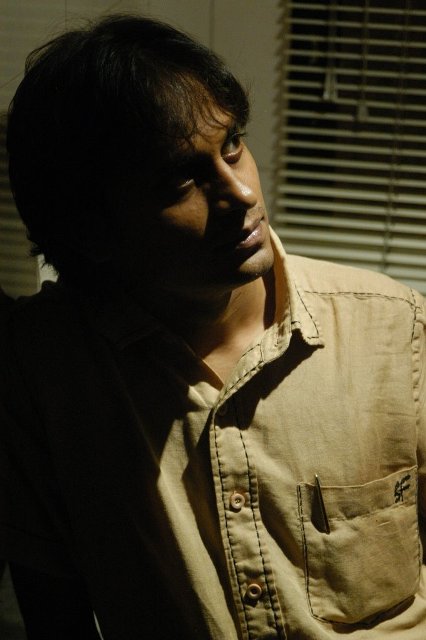
In da house
My friend Vikram smokes costly cigarettes. A single cigarette can cost thousands, he’s such a connoisseur.
The costliest he smoked was in a train. Those were the days when smoking wasn’t banned in trains. So he stood at the door, with earphones in his ear that were singing retro songs to him courtesy the walkman that was strapped to the belt above the left pocket. He thought it would be a great idea to inhale the fresh air of the endless plains and exhale his beloved ‘smoke’. So he put his hand in his pocket, took out a cigarette, lit it, puffed in. After a while he realized that the song had stopped playing. He reached for his walkman. As he was taking out his cigarette, the instrument decided to go for a walk in the UP plains, courtesy the pull of his hand. His was shaken but not stirred, and finished his sutta. It was a borrowed walkman, and the cigarette cost him Rs 2503.
Another costly smokey affair was again to do with a train. After long days of wandering during the vacation, Vikram had fifty bucks left in his pocket, just the right amount to take a general ticket back home from his last wandering spot. He had gone there to meet a friend who had a dialogue from Sholay for every situation in life. Vikram didn’t know there had been a train fire a few days back, and that inhaling the plains and puffing out tobacco was no longer possible. So, waiting for the train, he lit up a cigarette. Four cops pounced upon him together to collect their booty. Booty he had none, and so he refused to stop smoking, and offered to go to the jail. Friend’s friend had to come. He said, “Ab tera kya hoga kaalia,” but after joking a bit, paid for him. That sutta cost him Rs 203.
Another time, my friend acquired a new pair of frameless glasses. He used to go back to his flat at ten every night after dropping his girlfriend to her paying guest accommodation. Good boy didn’t smoke in front of her, but ran every day after dropping her, to a sutta shop that used to close five minutes after her place. That day either her PG shut later, or the shop shut earlier, but he saw the shutter coming down, and ran like Ben Johnson. Off went the specs, but he got his smoke. That cigarette cost him Rs 1003.
Tuesday, May 15, 2007

Monday, May 14, 2007
Surreal and Sadiyal
Gunda is a cult classic, and I being an AC of Gunda and Mithun da, had written a long article about Gunda fan club which worships the movie that has three rapes, thirteen murders and all dialogues in rhymes. The IITians had started the fan club, and so I was invited to their campus by a five-point-someone (FPS) for a screening of Loha, the complementary movie of Gunda. In one sequence, Shakti Kapoor comes to the adda of the villain and declares that he has tied bombs all around him and he’ll blow the place. So he blows the bomb and himself, and everybody else is left laughing.
“Quite a sadiyal movie,” I said, “How can a suicide bomber blow up while the rest are left blowing up their chewing gums?”
“That’s the beauty my friend. It is not sadiyal, it is surreal. It’s psychedelic, it’s science fiction, it is…”“Chill, I said. What is so surreal about it? Mithun da just must have decided that he’ll kill the villain, so he changed the script.”
“Come on, can’t you see the very elementary things,” FPS retorted.
“It is alimentary for sure. My alimentary canal and stomach are churning after seeing these random scenes,” I said.
“Come on dude. Surrealism is the reality. There are surreal numbers as well. Did you know there is a book called Surreal Numbers: How Two Ex-Students Turned on to Pure Mathematics and Found Total Happiness by Donald Knuth? It is the first novel arguably where mathematical concepts were presented through fictional tale,” FPS puffed on his cigarette with glee.
“And what could surreal numbers possibly be?” I asked, perplexed.
“Any number. Rational, irrational, infinitesimal, real, unreal,” he replied.
“Any number is surreal? That means all things real are surreal?” I exclaimed.
“Exactly,” said my friend, “you what Dali had said when he was called an eccentric? He said, ‘There’s only one difference between the madman and me. I am not mad.’”
“Yaar tum to dada ho,” I chuckled.
“Ya ya I believe in Dadaism, but not so much as in surrealism. The Dadaists believed that too much rational thought had brought about the misery of the world. They protested but did not evolve new forms, you see.”
I had figured out Gandhigiri a few days back but did not know they already had a counter-weapon in Dadaism.
Monday, May 07, 2007
beauty and the beast
We had the film Frankenstein for our film and literature course. The brightest girl in the class, Jharna, could be quite eponymous while watching horror films. So, behind her specs, she had a jharna flowing from her eyes. She twitched her fingers, occasionally plucked on the neighbour’s sleeve, and watched with rapt attention – one with the film.
So we teased her. “You are an unfeeling brute, what will you understand,” she retorted. “Come, it’s just one of those regular old horror films. It doesn’t even match the horror of the technology driven horror films of now,” I said. Another friend commented that a 19th century novel with funny English of that time isn’t quite indulging. He would realize very soon what it is like to pull a scholar into such a discussion.
“Did you know that the novel by Mary Shelley on which this film is based is the beginning of the genre of horror?” she asked.
“Might be,” my friend said, “but a woman cannot conjure up stories like say Bram Stoker’s Dracula.”“You are a thorough patriarch,” she said, “Did you know that this novel is a statement against patriarchy by Mary Shelley?”
That we didn’t know, for all that the novel is about is a war between Frankenstein, the scientist, and the monster he has created out of dead people. It’s about only men, so how could it possibly be a statement against men?
“Mary Shelley’s father William Godwin was believer in Utopia. But Utopia, which is often considered idyllic is not quite idyllic. There’s quite a lot of politics to it. Godwin’s utopia proposed that there’ll be world full of men who will live happily with themselves. It shows the kind of hold men have had over academia to have ignored this fact for so long,” she said.
“The monster in Frankenstein is a manifestation of that,” she continued, “a man making a man. Against nature’s law. And see what happens to that world. Mary was her mother’s daughter. Mary Wollstonecraft was the first one to write about the vindication of the rights of women.”
“But why were you crying so much then if the movie is against patriarchy,” I asked.
“Because poor Frankenstein is hounded so badly by the monster,” she replied.
Thursday, May 03, 2007
The story after Tees January
History has been written uptill Gandhi, and history is still Gandhi. There have been many books about Gandhi in the past few months. Tushar Gandhi feels it is coincidental with writers and deliberate with publishers post-Munnabhai. Ramachandra Guha won’t be happy with this introduction, for he insists that his new book India After Gandhi is not about Gandhi. “The keyword is ‘after’ and not ‘Gandhi’,” he says, “no one has taken post-independence history seriously. Historians are obsessed with Gandhi. History ends at January 30, 1948.I have spent years researching and thinking.”
Guha is precise in saying this, for the book is humungous, and deliberates upon issues and events at great length. Guha says he has a deep and abiding interest in Gandi, but the time after him has been ‘not studied and misunderstood.” There has been criticism, particularly by Amit Chaudhuri, that Guha hasn’t said much about cultural forms. “This is Bengali criticism,” Guha retorts, “No work of history is ever complete. Whatever you write, there’ll be such criticism. I took eight years to write these 800 pages.”
Guha has been a voracious writer of non-fiction, but to the question of venturing into fiction, he says, “it is beyond my competence. There is no dearth of historical books to write. It is very fortunate for a historian to be born in India.”
Does Guha, an alumnus of St. Stephen’s, believe in something called the Stephanian school of writing? “ In that college I learnt nothing about scholarship,” he chuckles, “it’s my years in Calcutta, Uttaranchal and Bangalore that have shaped me as a writer.” In college he was “a second class economics student and a second class cricketer,” and was therefore just “happy”. After the happy holidays, he ventured into serious scholarship that’s produced books on ecology, cricket, a biography of a missionary who settled in India, and more.
Every Indian is a scholar on Indian politics, and therefore this book is not to be missed to add to your scholarship.
Tuesday, May 01, 2007
Meeting a namesake
It was the fourth time I was meeting Vikram Seth after we had decided that March the 13 was an auspicious day. The other three had been professional visits, and this time he was on a personal visit to home. At the first meeting, he was excited that I was his namesake, for he was called Amit in his childhood. I never had thought before this that Amit is a very exciting name, for whenever you turn back hearing this name, someone else is being called. It is a coincidence that a series of short stories that I had written have a common protagonist called Vikram. Interestingly, there’s a Vikram Seth poem called Distressful Homonyms, and I am more than tempted to quote the first six lines from the poem:
Since for me now you have no warmth to spareI sense I must adopt a sane and spare Philosophy to ease a restless stateFuelled by this uncaring. It will state A very meagre truth: love like the restOf our emotions, sometimes needs a rest.
So we met to exchange greetings and ideas two days before the Ides of March at his Noida house. I cannot reach on time. So even though I had been waiting for days, I did not reach on time, and told him the traffic police had foiled my efforts. His wry smile told me he thought otherwise, but he was least irritated. “Let’s take a walk in the park, otherwise we’ll not be able to talk,” he said. So we went to the park and again decided that clockwise was a better direction to move in.
The subject of being Humnaan always comes in, and I was reminded of the poem quoted above. “Oh that was written when I was your age you know, the time when one is lovelorn,” he chuckled. His looked off into another time. I wondered what it would have been to drop out of a Stanford PhD after ten years of being in it, to decide to take destiny’s call of being a writer, when you were already past your twenties.
Vikram listened to me intently as if I were a close friend as I rambled about Alice’s grave in Pune with haunting epitaph, an Anglo-Indian beggar who spoke queen’s English, a military coup in a steel city, short story as a lost form. And he gave me the first lesson on becoming a writer, “When you staple pages, do not staple them diagonally on the left hand corner. They tear away.” I had taken a book for an autograph in which he signed as ‘Amit.’
Monday, April 30, 2007
Only Dr Joy
Election or no election, the city is strewn with posters of strange leaders with strange names, grinning teeth, folded hands, thanking Sonia Gandhi for something else or the other. If there’s one person that deserves posters across the city, it is Doctor Joy. ‘Only Doctor Joy’, the poster would shout. Head shaved closer than the cheek, thick specs, grim expression, thick drool, bloodshot eyes, cigarette dangling from the lips. Foucault’s reincarnation. But if you call him Mogambo, he’ll say, “Dr Joy dukhi hua”. So stick to Foucault. If any party needs a giant killer to defeat Sonia Gandhi or Vajpayee, call Doctor Joy.
The campaigning done, I must return to Dr Joy’s class. A very old and famous college, in an old and famous city, the classrooms still have wooden platforms. One fine morning Dr Joy walks in, and the terror struck students quietly take their seats. Dr Joy stares at them, and then his red eyes look in the distance. He lights his cigarette. He bangs his foot on the wooden platform. Everyone’s heart misses a couple of beats. “What happened,” Dr Joy’s voice quivers.
We stare at each other, our head hangs. None of us knows the mistake that has invited his wrath.
Dr Joy breaks the silence, “The earth is shaking. The oceans are shaking. The trees are shaking.” Under the doctor’s spell, might be we had missed the earthquake. The doctor continues, “The very being is shaking. Life is cruelty. Death is cruelty. Taking breath is cruelty.” I scratch the table with my fingers in anticipation of the cruelty that the doctor might unleash. The doc speaketh again, “It is all cruelty. From today we will study Antonin Artaud’s Theatre of Cruelty.”
We were supposed to be reading Vijay Tendulkar’s Ghashiram Kotwal but that did not surface in the next three months. “This shall sort you out and being,” was what the doc said if you brought up the subject matter. The name of the playwright was quite a tongue twister, it was Aa-kh-hto and not Ar-tau, and we got snubbed quite a few times for getting it wrong. Artaud looks somewhere between Foucault and Dr Joy, by the way. “We are determined to shatter false realities,” Dr Joy said at the end of the course. We did that by buying guides on Ghasiram Kotwal that could see us through to another year.
Friday, April 27, 2007
On the trail of a frail's man's foretold murder
There’s so much iron underneath the earth’s surface that ironies never fail to erupt. Gandhi’s famous last word “Ram” also happened to be his murderer’s name. Nathuram was not born with the name. Three of his elder brothers had died very young, and his father was told that no male child could survive in his family. And therefore, if a boy was born, he’d have to be brought up as a girl to fool destiny. So, a boy was born and was named Ramchandra but he was given a nose ring or a ‘nath’ to fool destiny. Children teased him as Nathuram, and he officially became that. He wanted to prove that he was a man. And the way he did it, on 30th January 1948, changed the course of history.
A death foretold
Another irony is that Tushar Gandhi’s book Let’s Kill Gandhi has received a lot of flak, but it so intrigued us that it set us groping for places where the conspiracy to kill Gandhi shaped up. The book reminds one of A Chronicle of a Death Foretold by Marquez where it’s known to everyone except the victim that he’s going to be killed. There’s a sense of frustration as one reads that between 20th January and 30th January 1948, the entire nation’s police could not pin down a bunch of amateur conspirators despite having sufficient leads. On 30th January, pamphlets announcing Gandhi’s murder were distributed three hours before the killing at Alwar. The ‘plot’ part of the book reads like a thriller, though one would agree with candid Tushar that he is ‘no great shakes as a writer.’
The killer car
The ‘plot’ in the book, which has also been enacted in Hey Ram, took us to the places where the conspirators stayed. The conspirators had stayed in Marina Hotel in CP when they were planning the killing to happen to happen on the 20th. On that day, they burst two cotton slabs meant to create commotion at Birla House, after which Badge was supposed to shoot from the grills of a servant quarter. They panicked and none of the conspirators shot. The car in which they had come and fled, was a Ford or a Studebaker, Tushar tells us. It was a blue-green “moongia” car, and unlike most cars in Delhi then, it had a carrier on its top. In the book, the writer tells us that it’s with a car collector in Lucknow, but in conversation he says that someone later told him that it was spotted in a vintage car rally in Delhi.
Marina
Coming back to Marina, it’s a plush hotel on the outer circle of CP today, with all the colonial artefacts – the arches, the pillars intact. Interestingly, a dental surgeon operates out of the place as well. We could not manage to get permission to shoot inside Room No 40. Tushar says the room doesn’t exist any longer, for when Kamal Hassan was planning to shoot there for Hey Ram, he learnt that the building houses a magazine company now. Anyways, coming back to the conspirators, it is here that they had checked in on 17th January 1948, Nathuram as M. Deshpande and Narayan Apte as S. Deshpande. However, when they were running off Nathuram left his shirt behind with the washerman with the real initials “NVG” which would become his undoing. They also left behind a press release by Asutosh Lahiri of Hindu Mahasabha denying his pledge of peace to Gandhi. He had pledged peace alongwith many leaders to make Gandhi break his fast-unto-death just days before.
Just as we were entering Marina, we had spotted a pair of shattered glasses. I clicked a picture. Interestingly, Gandhi’s glasses were never found after his death. When we were coming out the glasses were missing! Tushar chuckles, “This is my purpose, that your generation can connect with that moment.”
The only surviving witness
We go to Old Delhi thereafter, where most of the action happened in the next round when the murder happened. After their first attempt, Madanlal Pahwa was caught and the conspirators were wary, so most of them stayed at the old Delhi railway station abuzz with refugees, so they wouldn’t be detected. They got their pictures clicked in a studio, the name of which is not known now. We had an altercation in the retiring room in which they stayed, for ‘one doesn’t know these days who is who’ as the policeman put it. The other places the conspirators stayed in were Sharif Hotel in Fatehpuri, which doesn’t exist anymore.
The other place they stayed in was Frontier Hindu Hotel, near St. Stephen’s Church. It’s called New Frontier Hotel now. The owners are from North West Frontier Province, and therefore the name; and assertion of identity was also important in times of incendiary circumstances. Though, obviously they did away with the ‘Hindu’ tag after they had the infamous guests. The owner J. Bajaj told us it’s difficult to operate in the area as they have to be very discreet about which guests to entertain. They have a CCTV network to ensure they do not fall into a trap. When we mention his infamous visitors, he chuckles, “Oh, you also know. I got to know of it very late, not from my family but from a friend.” He is fond of historical research himself but is in a dilemma if this revelation would hamper his business. History, notoriously, is not about the past. We were in luck, for Mr Bajaj had an important visitor in his hotel – 85-year-old Ramprakash Matta, who was the manager of the hotel on Januiary 20 1948, when Gopal Godse had checked in as Rajagopalan, and Karakare as G.M.Joshi when they were fleeing after the failed attempt. The octogenarian says he remembers nothing of that time. He remembers his partition flight from Kohat to Rawalpindi to Anritsar to Jalandhar to Delhi very well though. Some memories are best buried, for as we said, history is not just about the past.
The fascist special
Beretta 9mm was the gun used to kill Gandhi. Before this gun was acquired at the last minute – Nathuram didn’t even know how to use it- there were two guns and both were not working. The Beretta, Tushar tells us in an interview, was used by Mussolini’s army in World War II, and had taken a long route to reach Godse. It was called the Fascist Special. The fascist gun that killed the pacifist, now lies in the Gandhi Museum in Delhi.
Subscribe to:
Posts (Atom)