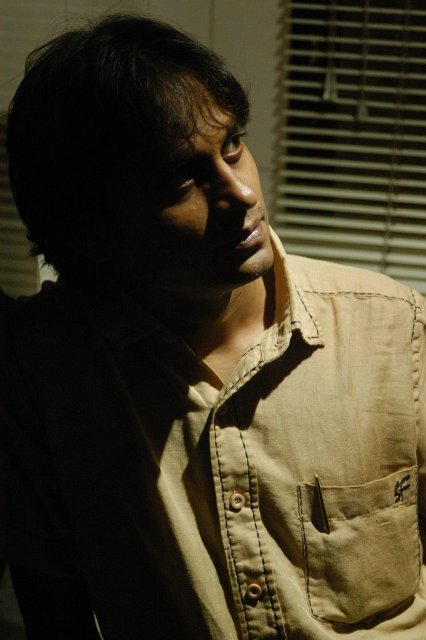
Election or no election, the city is strewn with posters of strange leaders with strange names, grinning teeth, folded hands, thanking Sonia Gandhi for something else or the other. If there’s one person that deserves posters across the city, it is Doctor Joy. ‘Only Doctor Joy’, the poster would shout. Head shaved closer than the cheek, thick specs, grim expression, thick drool, bloodshot eyes, cigarette dangling from the lips. Foucault’s reincarnation. But if you call him Mogambo, he’ll say, “Dr Joy dukhi hua”. So stick to Foucault. If any party needs a giant killer to defeat Sonia Gandhi or Vajpayee, call Doctor Joy.
The campaigning done, I must return to Dr Joy’s class. A very old and famous college, in an old and famous city, the classrooms still have wooden platforms. One fine morning Dr Joy walks in, and the terror struck students quietly take their seats. Dr Joy stares at them, and then his red eyes look in the distance. He lights his cigarette. He bangs his foot on the wooden platform. Everyone’s heart misses a couple of beats. “What happened,” Dr Joy’s voice quivers.
We stare at each other, our head hangs. None of us knows the mistake that has invited his wrath.
Dr Joy breaks the silence, “The earth is shaking. The oceans are shaking. The trees are shaking.” Under the doctor’s spell, might be we had missed the earthquake. The doctor continues, “The very being is shaking. Life is cruelty. Death is cruelty. Taking breath is cruelty.” I scratch the table with my fingers in anticipation of the cruelty that the doctor might unleash. The doc speaketh again, “It is all cruelty. From today we will study Antonin Artaud’s Theatre of Cruelty.”
We were supposed to be reading Vijay Tendulkar’s Ghashiram Kotwal but that did not surface in the next three months. “This shall sort you out and being,” was what the doc said if you brought up the subject matter. The name of the playwright was quite a tongue twister, it was Aa-kh-hto and not Ar-tau, and we got snubbed quite a few times for getting it wrong. Artaud looks somewhere between Foucault and Dr Joy, by the way. “We are determined to shatter false realities,” Dr Joy said at the end of the course. We did that by buying guides on Ghasiram Kotwal that could see us through to another year.
Monday, April 30, 2007

Friday, April 27, 2007
On the trail of a frail's man's foretold murder
There’s so much iron underneath the earth’s surface that ironies never fail to erupt. Gandhi’s famous last word “Ram” also happened to be his murderer’s name. Nathuram was not born with the name. Three of his elder brothers had died very young, and his father was told that no male child could survive in his family. And therefore, if a boy was born, he’d have to be brought up as a girl to fool destiny. So, a boy was born and was named Ramchandra but he was given a nose ring or a ‘nath’ to fool destiny. Children teased him as Nathuram, and he officially became that. He wanted to prove that he was a man. And the way he did it, on 30th January 1948, changed the course of history.
A death foretold
Another irony is that Tushar Gandhi’s book Let’s Kill Gandhi has received a lot of flak, but it so intrigued us that it set us groping for places where the conspiracy to kill Gandhi shaped up. The book reminds one of A Chronicle of a Death Foretold by Marquez where it’s known to everyone except the victim that he’s going to be killed. There’s a sense of frustration as one reads that between 20th January and 30th January 1948, the entire nation’s police could not pin down a bunch of amateur conspirators despite having sufficient leads. On 30th January, pamphlets announcing Gandhi’s murder were distributed three hours before the killing at Alwar. The ‘plot’ part of the book reads like a thriller, though one would agree with candid Tushar that he is ‘no great shakes as a writer.’
The killer car
The ‘plot’ in the book, which has also been enacted in Hey Ram, took us to the places where the conspirators stayed. The conspirators had stayed in Marina Hotel in CP when they were planning the killing to happen to happen on the 20th. On that day, they burst two cotton slabs meant to create commotion at Birla House, after which Badge was supposed to shoot from the grills of a servant quarter. They panicked and none of the conspirators shot. The car in which they had come and fled, was a Ford or a Studebaker, Tushar tells us. It was a blue-green “moongia” car, and unlike most cars in Delhi then, it had a carrier on its top. In the book, the writer tells us that it’s with a car collector in Lucknow, but in conversation he says that someone later told him that it was spotted in a vintage car rally in Delhi.
Marina
Coming back to Marina, it’s a plush hotel on the outer circle of CP today, with all the colonial artefacts – the arches, the pillars intact. Interestingly, a dental surgeon operates out of the place as well. We could not manage to get permission to shoot inside Room No 40. Tushar says the room doesn’t exist any longer, for when Kamal Hassan was planning to shoot there for Hey Ram, he learnt that the building houses a magazine company now. Anyways, coming back to the conspirators, it is here that they had checked in on 17th January 1948, Nathuram as M. Deshpande and Narayan Apte as S. Deshpande. However, when they were running off Nathuram left his shirt behind with the washerman with the real initials “NVG” which would become his undoing. They also left behind a press release by Asutosh Lahiri of Hindu Mahasabha denying his pledge of peace to Gandhi. He had pledged peace alongwith many leaders to make Gandhi break his fast-unto-death just days before.
Just as we were entering Marina, we had spotted a pair of shattered glasses. I clicked a picture. Interestingly, Gandhi’s glasses were never found after his death. When we were coming out the glasses were missing! Tushar chuckles, “This is my purpose, that your generation can connect with that moment.”
The only surviving witness
We go to Old Delhi thereafter, where most of the action happened in the next round when the murder happened. After their first attempt, Madanlal Pahwa was caught and the conspirators were wary, so most of them stayed at the old Delhi railway station abuzz with refugees, so they wouldn’t be detected. They got their pictures clicked in a studio, the name of which is not known now. We had an altercation in the retiring room in which they stayed, for ‘one doesn’t know these days who is who’ as the policeman put it. The other places the conspirators stayed in were Sharif Hotel in Fatehpuri, which doesn’t exist anymore.
The other place they stayed in was Frontier Hindu Hotel, near St. Stephen’s Church. It’s called New Frontier Hotel now. The owners are from North West Frontier Province, and therefore the name; and assertion of identity was also important in times of incendiary circumstances. Though, obviously they did away with the ‘Hindu’ tag after they had the infamous guests. The owner J. Bajaj told us it’s difficult to operate in the area as they have to be very discreet about which guests to entertain. They have a CCTV network to ensure they do not fall into a trap. When we mention his infamous visitors, he chuckles, “Oh, you also know. I got to know of it very late, not from my family but from a friend.” He is fond of historical research himself but is in a dilemma if this revelation would hamper his business. History, notoriously, is not about the past. We were in luck, for Mr Bajaj had an important visitor in his hotel – 85-year-old Ramprakash Matta, who was the manager of the hotel on Januiary 20 1948, when Gopal Godse had checked in as Rajagopalan, and Karakare as G.M.Joshi when they were fleeing after the failed attempt. The octogenarian says he remembers nothing of that time. He remembers his partition flight from Kohat to Rawalpindi to Anritsar to Jalandhar to Delhi very well though. Some memories are best buried, for as we said, history is not just about the past.
The fascist special
Beretta 9mm was the gun used to kill Gandhi. Before this gun was acquired at the last minute – Nathuram didn’t even know how to use it- there were two guns and both were not working. The Beretta, Tushar tells us in an interview, was used by Mussolini’s army in World War II, and had taken a long route to reach Godse. It was called the Fascist Special. The fascist gun that killed the pacifist, now lies in the Gandhi Museum in Delhi.
A death foretold
Another irony is that Tushar Gandhi’s book Let’s Kill Gandhi has received a lot of flak, but it so intrigued us that it set us groping for places where the conspiracy to kill Gandhi shaped up. The book reminds one of A Chronicle of a Death Foretold by Marquez where it’s known to everyone except the victim that he’s going to be killed. There’s a sense of frustration as one reads that between 20th January and 30th January 1948, the entire nation’s police could not pin down a bunch of amateur conspirators despite having sufficient leads. On 30th January, pamphlets announcing Gandhi’s murder were distributed three hours before the killing at Alwar. The ‘plot’ part of the book reads like a thriller, though one would agree with candid Tushar that he is ‘no great shakes as a writer.’
The killer car
The ‘plot’ in the book, which has also been enacted in Hey Ram, took us to the places where the conspirators stayed. The conspirators had stayed in Marina Hotel in CP when they were planning the killing to happen to happen on the 20th. On that day, they burst two cotton slabs meant to create commotion at Birla House, after which Badge was supposed to shoot from the grills of a servant quarter. They panicked and none of the conspirators shot. The car in which they had come and fled, was a Ford or a Studebaker, Tushar tells us. It was a blue-green “moongia” car, and unlike most cars in Delhi then, it had a carrier on its top. In the book, the writer tells us that it’s with a car collector in Lucknow, but in conversation he says that someone later told him that it was spotted in a vintage car rally in Delhi.
Marina
Coming back to Marina, it’s a plush hotel on the outer circle of CP today, with all the colonial artefacts – the arches, the pillars intact. Interestingly, a dental surgeon operates out of the place as well. We could not manage to get permission to shoot inside Room No 40. Tushar says the room doesn’t exist any longer, for when Kamal Hassan was planning to shoot there for Hey Ram, he learnt that the building houses a magazine company now. Anyways, coming back to the conspirators, it is here that they had checked in on 17th January 1948, Nathuram as M. Deshpande and Narayan Apte as S. Deshpande. However, when they were running off Nathuram left his shirt behind with the washerman with the real initials “NVG” which would become his undoing. They also left behind a press release by Asutosh Lahiri of Hindu Mahasabha denying his pledge of peace to Gandhi. He had pledged peace alongwith many leaders to make Gandhi break his fast-unto-death just days before.
Just as we were entering Marina, we had spotted a pair of shattered glasses. I clicked a picture. Interestingly, Gandhi’s glasses were never found after his death. When we were coming out the glasses were missing! Tushar chuckles, “This is my purpose, that your generation can connect with that moment.”
The only surviving witness
We go to Old Delhi thereafter, where most of the action happened in the next round when the murder happened. After their first attempt, Madanlal Pahwa was caught and the conspirators were wary, so most of them stayed at the old Delhi railway station abuzz with refugees, so they wouldn’t be detected. They got their pictures clicked in a studio, the name of which is not known now. We had an altercation in the retiring room in which they stayed, for ‘one doesn’t know these days who is who’ as the policeman put it. The other places the conspirators stayed in were Sharif Hotel in Fatehpuri, which doesn’t exist anymore.
The other place they stayed in was Frontier Hindu Hotel, near St. Stephen’s Church. It’s called New Frontier Hotel now. The owners are from North West Frontier Province, and therefore the name; and assertion of identity was also important in times of incendiary circumstances. Though, obviously they did away with the ‘Hindu’ tag after they had the infamous guests. The owner J. Bajaj told us it’s difficult to operate in the area as they have to be very discreet about which guests to entertain. They have a CCTV network to ensure they do not fall into a trap. When we mention his infamous visitors, he chuckles, “Oh, you also know. I got to know of it very late, not from my family but from a friend.” He is fond of historical research himself but is in a dilemma if this revelation would hamper his business. History, notoriously, is not about the past. We were in luck, for Mr Bajaj had an important visitor in his hotel – 85-year-old Ramprakash Matta, who was the manager of the hotel on Januiary 20 1948, when Gopal Godse had checked in as Rajagopalan, and Karakare as G.M.Joshi when they were fleeing after the failed attempt. The octogenarian says he remembers nothing of that time. He remembers his partition flight from Kohat to Rawalpindi to Anritsar to Jalandhar to Delhi very well though. Some memories are best buried, for as we said, history is not just about the past.
The fascist special
Beretta 9mm was the gun used to kill Gandhi. Before this gun was acquired at the last minute – Nathuram didn’t even know how to use it- there were two guns and both were not working. The Beretta, Tushar tells us in an interview, was used by Mussolini’s army in World War II, and had taken a long route to reach Godse. It was called the Fascist Special. The fascist gun that killed the pacifist, now lies in the Gandhi Museum in Delhi.
Daler Paa ji's Pop Sufism
The other day, our editor showed me a clipping of Murli Qawwal’s performance on youtube.com. In the small clipping, the Lucknow-based qawwal demonstrates the technique and power of repetition and chanting of phrases, one of the most powerful and potent tools of the genre. Apparently, Ustad Nusrat fateh Ali Khan was a fan of Murli. This is written in the caption of the clipping that is more than thirty years old, with a bedsheet on the wall, and the singers lookingly visibly ‘not-well-off’.
The other image of a qawwal that’s struck me is that of the singers at Haji Ali in Mumbai. The blind father and his son sing in the afternoons and get some alms for their performance from the visitors. A R Rahman’s Piya Haji Ali is most probably inspired from their singing style. I spend the entire afternoon listening to them whenever I am in Mumbai.
Qawwali’s taqdeer is no longer stuck with the faqeer image; it has had its renaissance to the extent that it’s now a fad. When I met Rahat Fateh Ali Khan, he said he was happy that qawwali has entered the imagination of the elite class, so that it pervades across the society now. But when something enters the elite homes, the fear is of ‘no-return’. So an average person with an average income cannot go to Jahan-e-Khusrau now.
Everyone in the singing world who wants to be someone must have a qawwali tag these days. So Daler Pa ji came to perform Sufi at the Central Park in CP with huge posters shouting “Daler Sufi”. The park was jampacked, the atmosphere electric, the guest list included Sheila Dikshit. So Daler, in his black shirt and shiny silver overcoat started singing Sadde Naal Rahoge Te Aish Karoge. He realized it wasn’t quite Sufi, and peppered his pop songs with a few lines of Nusrat songs here and there. Na Na Na Re…Ali Da Malang…Sadde Naal…Mast Qalandar. Junta whirled with hisses, flying kisses. Rag tag hiss hass people, Shakespeare would have said. The crowd, however, had variety, with whistle blowers to oglers to foreigners to couples. After a while, after the chief guest had left, the compere announced, “I request families and children to slowly move out of the main area as we are increasing the tempo now. We want you to enjoy.” And Paa ji dropped Sufism for another day so that junta could do their dirty dancing to Na Na Na Na Re.
Sufism, one thought was all inclusive, and one also thought that Daler’s pop-Sufism is a countercultural movement to the elite Jahan-e-Khusrau. But it seems Bulle Shah’s or Amir Khusrau’s poetry cannot quite match Sadde Naal.
The other image of a qawwal that’s struck me is that of the singers at Haji Ali in Mumbai. The blind father and his son sing in the afternoons and get some alms for their performance from the visitors. A R Rahman’s Piya Haji Ali is most probably inspired from their singing style. I spend the entire afternoon listening to them whenever I am in Mumbai.
Qawwali’s taqdeer is no longer stuck with the faqeer image; it has had its renaissance to the extent that it’s now a fad. When I met Rahat Fateh Ali Khan, he said he was happy that qawwali has entered the imagination of the elite class, so that it pervades across the society now. But when something enters the elite homes, the fear is of ‘no-return’. So an average person with an average income cannot go to Jahan-e-Khusrau now.
Everyone in the singing world who wants to be someone must have a qawwali tag these days. So Daler Pa ji came to perform Sufi at the Central Park in CP with huge posters shouting “Daler Sufi”. The park was jampacked, the atmosphere electric, the guest list included Sheila Dikshit. So Daler, in his black shirt and shiny silver overcoat started singing Sadde Naal Rahoge Te Aish Karoge. He realized it wasn’t quite Sufi, and peppered his pop songs with a few lines of Nusrat songs here and there. Na Na Na Re…Ali Da Malang…Sadde Naal…Mast Qalandar. Junta whirled with hisses, flying kisses. Rag tag hiss hass people, Shakespeare would have said. The crowd, however, had variety, with whistle blowers to oglers to foreigners to couples. After a while, after the chief guest had left, the compere announced, “I request families and children to slowly move out of the main area as we are increasing the tempo now. We want you to enjoy.” And Paa ji dropped Sufism for another day so that junta could do their dirty dancing to Na Na Na Na Re.
Sufism, one thought was all inclusive, and one also thought that Daler’s pop-Sufism is a countercultural movement to the elite Jahan-e-Khusrau. But it seems Bulle Shah’s or Amir Khusrau’s poetry cannot quite match Sadde Naal.
Nishabd with Zonko Junkies
I had gone to watch Nishabd with my ‘zonko junkie’ literary friends. The term is self proclaimed, and so I have no explanation for it. One of them remarked over Amitabh Bachchan’s predicament in the film, “Such is life and so much is life.”
“Dude, the man is a picaresque hero. Such random energy in his ageing eyes,” Markandey, popularly called makdi, butted in.
“Where is any picaresque element dude? The hero is not a picaro, he is not a rogue, neither does he go on any adventure to augur such a classification,” Sunil Kumar alias Ass Kay retorted to the idea.
“Now now,” I said mighty confused, “the picture is indeed picturesque with all the valleys and the thunder thighs of Jia Khan, but I see no Picasso anywhere.”
“Fool, Picaro not Picasso,” Makdi mocked at me, “Picaro is a Spanish hero who’s a rogue and goes on all these adventures. And Picaresque is a derivative.”
“Rogue I can’t see, but I could see that the old man had some sort of a rog. As in sickness, you see, falling for this young girl and spoiling it all,” I said.
Ass Kay was in splits, “Man this guy is too much. He is a rogue and he is sick. He is almost Kafkaesque, with his surreal humour and all, that is if he intends it.”
Ass Kay’s addition of a new ‘esque’ had totally stumped me, and Makdi added, “Yeah yeah this dude needs to be metamorphosed into a spider weaving stupid trans-lingual puns, like the hero of Kafka’s Metamorphosis.”
Ass Kay showed off some off his knowledge quoting the first line of that book, “As Gregor Samsa awoke one morning from uneasy dreams he found himself transformed in his bed into a gigantic insect.”
“Ungeziefer is the word for insect in German original by Kafka,” Makdi said not to be left behind, “and you know what, the creator of Lolita, Nabokov, was himself an entomologist.”
While I grappled with the meaning of ‘entomologist’, Makdi said, “Nabokov had researched that Gregor Samsa had got converted to no other insect but a beetle, with wings under his shell, and he could fly if only he had known this fact.”
I figured myself as Gregor Samsa, the beetle, and started looking for wings under my shell to take a long flight far away from the zonko junkies.
“Dude, the man is a picaresque hero. Such random energy in his ageing eyes,” Markandey, popularly called makdi, butted in.
“Where is any picaresque element dude? The hero is not a picaro, he is not a rogue, neither does he go on any adventure to augur such a classification,” Sunil Kumar alias Ass Kay retorted to the idea.
“Now now,” I said mighty confused, “the picture is indeed picturesque with all the valleys and the thunder thighs of Jia Khan, but I see no Picasso anywhere.”
“Fool, Picaro not Picasso,” Makdi mocked at me, “Picaro is a Spanish hero who’s a rogue and goes on all these adventures. And Picaresque is a derivative.”
“Rogue I can’t see, but I could see that the old man had some sort of a rog. As in sickness, you see, falling for this young girl and spoiling it all,” I said.
Ass Kay was in splits, “Man this guy is too much. He is a rogue and he is sick. He is almost Kafkaesque, with his surreal humour and all, that is if he intends it.”
Ass Kay’s addition of a new ‘esque’ had totally stumped me, and Makdi added, “Yeah yeah this dude needs to be metamorphosed into a spider weaving stupid trans-lingual puns, like the hero of Kafka’s Metamorphosis.”
Ass Kay showed off some off his knowledge quoting the first line of that book, “As Gregor Samsa awoke one morning from uneasy dreams he found himself transformed in his bed into a gigantic insect.”
“Ungeziefer is the word for insect in German original by Kafka,” Makdi said not to be left behind, “and you know what, the creator of Lolita, Nabokov, was himself an entomologist.”
While I grappled with the meaning of ‘entomologist’, Makdi said, “Nabokov had researched that Gregor Samsa had got converted to no other insect but a beetle, with wings under his shell, and he could fly if only he had known this fact.”
I figured myself as Gregor Samsa, the beetle, and started looking for wings under my shell to take a long flight far away from the zonko junkies.
Wednesday, April 18, 2007
Piggy on the Railway
Oil, fish and coal
And a billion whole
Traverse a million miles
On the parallel lines.
If there's a nerve of this country that hasn't cracked as yet, it isthe parallel lines. The parallel lines of Indian Railways, perhaps thecheapest in the world that ferries you at a rupee a kilometer even inAC coaches. The idea of going round Delhi in one and a half hours flatand covering 36 stations is a fascinating idea.
Delhi Avoided Line
The Ring rail service was introduced in the 1970s before the Asiad asa 'Delhi Avoiding Lines', to ferry passengers inside the city anddecongested the four major stations. Thirty years down the line, veryfew people know about it, and the Delhi planning website,delhiplanning.nic.in, tells that the ring rail handles only one percent of the passengers. It's become the avoided line, rather than theavoiding line. Reason? The stations are invisible, it took me half anhour to figure out the Safdarjung railway station. There are noconnecting buses, no landmarks, definitely unsafe at nights. And aboveall, there are only two trains in the morning and two in the evening.So despite amazing speed, and dirt cheap prices, it's not happening.
Ticket babu kahan hai?
We missed the ring rail service courtesy its timings and paucity, butthere was one Nizamuddin bound train waiting. We wanted the tickets,but the ticket collector didn't want us. So he was missing. Apoliceman told us that we are not supposed to click pictures.Safdargunj must be a classified station, for we haven't ever heardthis even at New Delhi. After much hue and cry, the station masterhimself gave us the tickets.The Lonely IslandThe gross underutilization can be gauged from the fact that you canalmost play cricket in the train; it's so empty. The ladies compartment doesn't obviously hold any significance and anyone sitsanywhere. Even at the station you have to hunt for people atSafdarjung. The policemen were packing children – must be for juvenilecrimes – in an auto; they were laying a red carpet for The Palace onWheels and the children were adequately removed before the VIP guestsarrived. Inside the train, the commuters are generally smallbusinessman. So you'll find a fruit seller, a utensil vendor who worksat hundred rupees a day. And Sadhus, sleeping away to glory travelingrandomly in circles. It's almost Romantic, the whole languidity of it.
The Engine Drive
My friend, the photographer, missed climbing on the train eitherbecause of his paunch or his camera, at one of the stations he'd gotdown at. So we wave at an oncoming engine and get a lift. Liaqat Khanis the driver and tells us about his grueling schedule which hasprompted him to study engineering as a part time course. Next year,he'll have a degree to get off the parallel lines. We cross SewaNagar, Lodhi Colony, Nizamuddin and they look very different from whatthey look from outside. The tracks are laid in the body of the city,and not the skin, and the body doesn't appear very healthy. They areplastic bags strewn all over, you cross all jhuggis, and see theinteriors of UP in the heart of Delhi. At the Okhla station we have nooption but to wait an hour for the next train which is an express, andwhich we miss again. In the meanwhile we roam around to see a barber'sshop full of Tere Naam and Himesh Reshammiya, a quack doctor, milkvendors. The milk vendors have a harrowing journey back to Haryanawith train upto only Palwal in the afternoon, after which they have totake tempos. There's variety here, college going girls, bidi smokinguncles, and a girl lying on the floor, with the world oblivious to herbut the flies sensitive to every inch of her body.
Years ago, I had read a very romantic account of the ring rail – thesunset, the trees in the background, the serenity. It's there, butwhat we saw, also exists, and glares.
And a billion whole
Traverse a million miles
On the parallel lines.
If there's a nerve of this country that hasn't cracked as yet, it isthe parallel lines. The parallel lines of Indian Railways, perhaps thecheapest in the world that ferries you at a rupee a kilometer even inAC coaches. The idea of going round Delhi in one and a half hours flatand covering 36 stations is a fascinating idea.
Delhi Avoided Line
The Ring rail service was introduced in the 1970s before the Asiad asa 'Delhi Avoiding Lines', to ferry passengers inside the city anddecongested the four major stations. Thirty years down the line, veryfew people know about it, and the Delhi planning website,delhiplanning.nic.in, tells that the ring rail handles only one percent of the passengers. It's become the avoided line, rather than theavoiding line. Reason? The stations are invisible, it took me half anhour to figure out the Safdarjung railway station. There are noconnecting buses, no landmarks, definitely unsafe at nights. And aboveall, there are only two trains in the morning and two in the evening.So despite amazing speed, and dirt cheap prices, it's not happening.
Ticket babu kahan hai?
We missed the ring rail service courtesy its timings and paucity, butthere was one Nizamuddin bound train waiting. We wanted the tickets,but the ticket collector didn't want us. So he was missing. Apoliceman told us that we are not supposed to click pictures.Safdargunj must be a classified station, for we haven't ever heardthis even at New Delhi. After much hue and cry, the station masterhimself gave us the tickets.The Lonely IslandThe gross underutilization can be gauged from the fact that you canalmost play cricket in the train; it's so empty. The ladies compartment doesn't obviously hold any significance and anyone sitsanywhere. Even at the station you have to hunt for people atSafdarjung. The policemen were packing children – must be for juvenilecrimes – in an auto; they were laying a red carpet for The Palace onWheels and the children were adequately removed before the VIP guestsarrived. Inside the train, the commuters are generally smallbusinessman. So you'll find a fruit seller, a utensil vendor who worksat hundred rupees a day. And Sadhus, sleeping away to glory travelingrandomly in circles. It's almost Romantic, the whole languidity of it.
The Engine Drive
My friend, the photographer, missed climbing on the train eitherbecause of his paunch or his camera, at one of the stations he'd gotdown at. So we wave at an oncoming engine and get a lift. Liaqat Khanis the driver and tells us about his grueling schedule which hasprompted him to study engineering as a part time course. Next year,he'll have a degree to get off the parallel lines. We cross SewaNagar, Lodhi Colony, Nizamuddin and they look very different from whatthey look from outside. The tracks are laid in the body of the city,and not the skin, and the body doesn't appear very healthy. They areplastic bags strewn all over, you cross all jhuggis, and see theinteriors of UP in the heart of Delhi. At the Okhla station we have nooption but to wait an hour for the next train which is an express, andwhich we miss again. In the meanwhile we roam around to see a barber'sshop full of Tere Naam and Himesh Reshammiya, a quack doctor, milkvendors. The milk vendors have a harrowing journey back to Haryanawith train upto only Palwal in the afternoon, after which they have totake tempos. There's variety here, college going girls, bidi smokinguncles, and a girl lying on the floor, with the world oblivious to herbut the flies sensitive to every inch of her body.
Years ago, I had read a very romantic account of the ring rail – thesunset, the trees in the background, the serenity. It's there, butwhat we saw, also exists, and glares.
of evenings and eve teasers
JNU's Ganga Dhaba is open till three in morning, and therefore itattracts a huge crowd, not just of students of campus, but also'elements from outside'. And some of these 'elements', seeing girls ofthe campus sip cups of coffee alone, think they are 'available.' Oreven if they don't think that, they definitely think they have alicense for cheap thrills. So there was this group of girls sippingcoffee near the condom vending machine, which serves a hundred foldmore as a coffee vendor than otherwise as the media would like theworld to believe. Anyways, there were these four guys from Ber Sarai,a place nearby that houses UPSC fighters, media persons and localloafers.So the boys winked at the girls, passed some lewd comments, asked fortheir numbers. Someone intervened and they followed the usual patternof "Do you know whose son I am? Come to Ber Sarai and we'll tell youthere" The students got incensed, the Group 4 guards were called.There is nothing unusual about this scene. It's routine. Lessons areoften taught, but never learnt. So the guards came, and now the boyswere on their guard. They begged for apology, but that too withattitude, "Yaar uncle maaf kar do." And yaar uncle unleash a volley offist fury and gave them quite a sound thrashing. Kicks, fists, headsbanged against each other. It was a spectacle. A crowd had gathered,and it seemed they'd be beaten up by everyone. They were whisked awayin the van in good time.What the guys did is abhorrent, but one wondered if the reaction isjustified. I've heard it's a deterrent – to beat them up black andblue - but how do incidents recur if it's a deterrent. If weapons area deterrent, how do wars happen? One wonders whether the crowds thatgather are themselves free of eve teasers? When these tales arerecounted by someone, One always jingoistically reeacts, "Achha kiyamaara saalon ko." But the spectacle made me rethink.I was reading Let's Kill Gandhi by Tushar Gandhi the other day.Nathuram killed the Father of the Nation amidst a crowd of eighthundred people, and lived to see his trial. I haven't heard of such acrowd ever before. The counter argument of course is, had Gandhiallowed securitymen with guns, it would never have happened.I do not have answers, but have questions for sure that need to be mulled upon.
Tuesday, April 17, 2007
freaky flukes
Co-incidences never cease to amaze me though I believe they are ahabit with me. So, the other day, I had written about old movie hallsin which I had quoted an elderly gentleman saying no one named theirchildren Pran. The next day, we were chatting downstairs, teasingBarmaulah about his name. He said he's the only one with his name,unlike my name which is a common password. Panditji pan wale butted infrom behind, "His name is not the only unique one. Pran is a uniquename. Tell me one man whose name is Pran."Days before that I had declared in the office that Karan Singh, A KHangal and Mac Mohan were all born aged sixty years. Two days later,Karan Singh launched a biography on him and I was there; and two daysafter that I opened a newspaper to see a full page interview of A KHangal. Ann then there was A K Hangal all over the TV declaring MeraBharat Jawan. My features editor had declared Mac Mohan dead. Andthen I got an invite for the launch of a book called Ab Tera Kya HogaKalia, (a memory improvement technique book!) a title which has sofascinated me that I have already written about it twice. And therewas Mac Mohan, wielding a gun, in a coolie-red kurta, same beard, samepartially grey hair – back from the dead. I couldn't tell him how muchI adore him, and that his picture would become the wallpaper of mycomputer for a few days. Instead I pissed him off by questioning himabout his being the quintessential B grader and a perfect sidekick. Hedidn't know these were compliments.I was disappointed that the 'Mac' in Mac Mohan was not connotative ofa clan, like in Mc Donald or Mc Leod. In McLeodgunj, I had been to thechurch of St John, "in the wilderness". It has a graveyard that hasintriguing epitaphs. I had been grave hunting for a few days, and themost intriguing one had been of Alice, in Pune, who was "born atMelrose in Australia' and had died and was buried at the same spot.So, in St John's church, there was this grave of A. Rose fromMelbourne. A little juggling took me back to both Alice and Melrose.The church, by the way also has a memorial for James Bruce, morefamously known as Lord Elgin. So A Rose's epitaph said, just for itsintrigue value, "The flesh shall fly back to earth, and the soul shallfly off from the flesh."
Subscribe to:
Posts (Atom)